What Reply Rate Is Normal for B2B Cold Email in 2027? Reply and Meeting Rates for a Short List
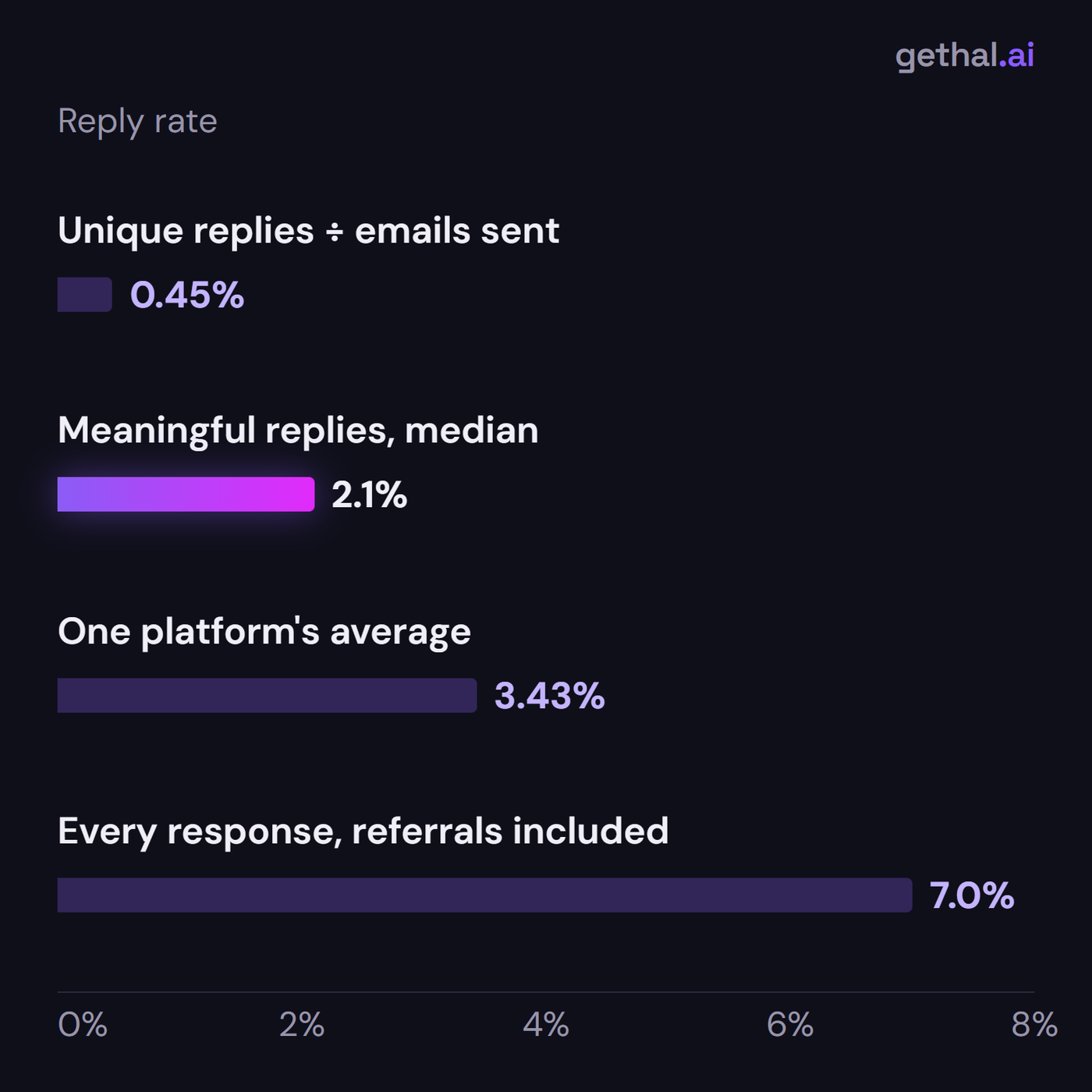
Published cold email reply rates run from 0.45% to 7.0%, median 2.1%, as each counts something else. On 50 companies: 1 to 10 replies, half a meeting.
Contents6 sections
Three replies from 50 companies after a month of cold email can feel like a verdict. At the median reply rate we found, three emails to each would bring 3.2 replies, so that month is normal.
This is for the founder or owner who still sells, with 30 to 60 companies on a list. You'll be able to read a published rate for what it counts and work out your own.
How we put this together. Between 11 and 18 November 2026 we read five published datasets of cold email replies and meetings, from senders' campaigns and tools' users. The sums and the counting method are ours.
What reply rate is normal for B2B cold email?
In our research, published reply rates for cold email run from 0.45% to 7.0%, and the one median, across 47 B2B outbound programmes in 2026, is 2.1%. Each figure counts a different kind of reply and divides by a different base, so a rate is normal only beside one that counts the same way.
| Rate | Whose emails | Sample and period | What counts as a reply | Divided by |
|---|---|---|---|---|
| 0.45% average | One company's client campaigns | 7,530,489 emails, 2025 | Unique replies, no auto-replies or bounces | Emails sent |
| 2.1% median; quartiles 0.6% and 4.4% | 47 B2B client outbound programmes of one company | 28,400 leads, January 2024 to March 2026 | Meaningful replies: interest or a qualified objection | Not stated |
| 3.43% average; top quarter 5.5% or more | One platform's users | 1 January to 18 December 2025 | Replies; no positive-reply or meeting rate given | Not stated |
| 7.0% response rate | One company's own managed campaigns | 87,015 B2B emails, period not stated | Every response, referrals and requests to reconnect later included | Emails analysed |
All five datasets come from senders rather than random samples, each from one company's clients or one tool's users. We read the 2.1% median on 18 November 2026 and the other three rates in the table on 12 November 2026.
Name the denominator
Before you set two reply rates side by side, write down what each counts and what it divides by. A referral to a colleague is a reply in the 7.0% and not in the 0.45%. The 2.1% leaves out unsubscribes, which a raw reply count keeps. Your own rate needs the same two labels, and our free outbound scorecard (Excel) puts them on every rate it works out.
Book a demo to see the outreach brief and suggested first email HAL, gethal.ai's AI sales agent, writes for each company you plan to contact. Book a demo
What meeting rate is normal?
Two of the datasets give meetings, and they sit about 20 times apart. One is a median of 0.34% in 2026, down from 0.78% in 2022, across the same 47 programmes as the 2.1% reply rate. In the other, over 1,200 appointments from 7,530,489 emails in 2025 work out at about 0.016%, by our sum.
| Meeting rate | Sample and period | What counts as a meeting | Per 10,000 emails |
|---|---|---|---|
| 0.34% median (0.78% in 2022) | 47 B2B client programmes, January 2024 to March 2026 | Calendar events linked to the outbound source; formula not stated, its funnel example implies emails sent | 34 |
| About 0.016%, our sum | "Over 1,200 appointments" from 7,530,489 emails, 2025 | Appointments across one company's client campaigns | 1.6 |
Three things pull the two apart. They count different events: calendar events traced to outbound on one side, appointments across a whole client book on the other. The median gives each of the 47 programmes the same weight, while the 0.016% is one total over 7.5 million emails, where the largest senders weigh most. And the median doesn't state its divisor.
One dataset gives a step in between: a 1.7% interest rate across 87,015 emails, with no divisor given. All of these are rates per email across thousands of emails; on a short list they turn into fractions of a meeting, as the sums below show.
Why do small lists reply more, and does the median keep falling?
Across 31 million emails sent in 2025, sequences of 21 to 50 recipients drew a 6.2% reply rate, against 2.4% for sequences of 500 or more. And across the 47 B2B programmes, the median fell from 4.7% in 2022 to 2.1% in 2026. Both change what a published rate means for your list.
Smaller sequences, more replies
A sequence is one batch of recipients set up in a sending tool, so sequence size isn't list size: 500 companies sent in batches of 50 count as small sequences. The same 31 million emails, read on 11 November 2026, show a second split: 3.6% for an email body with no personalisation against 5.6% with two custom attributes. The data shows these go together, not which causes which. For a founder writing to 50 companies, the 21 to 50 band is the nearer comparison, provided you count replies the way that dataset does.
Rates from 2022 set the bar too high
The meeting rate in those programmes fell by about as much as the reply rate, from 0.78% to 0.34%. They are one company's clients, so read the direction rather than the exact size. In those programmes, the 2022 median was more than twice the 2026 one, so check the year of any rate before you hold yours against it.
Book a demo to see what HAL finds out about each company on a short list before the first email. Book a demo
What do these rates give for 50 companies?
At three emails per company, 50 companies are 150 emails. By our sum, the published reply rates give between 0.7 and 10.5 replies from them, 3.2 at the 2.1% median, and the 0.34% median meeting rate gives half a meeting. A month with three replies and no meeting sits inside that range.
| Published rate | What it counts | From 150 emails (our sum) |
|---|---|---|
| 0.45% | Unique replies ÷ emails sent | 0.7 replies |
| 2.1% median | Meaningful replies | 3.2 replies |
| 3.43% | One platform's average | 5.1 replies |
| 7.0% | Every response, referrals included | 10.5 replies |
| 0.34% median meeting rate | Calendar events from outbound | 0.5 meetings |
Three emails per company is the plan in our article on cold email follow-ups.
Spread over weeks, the same rates set the pace. Say research and drafting take 20 minutes a company: 15 for the checks in our company research checklist, and 5, our estimate, for the draft. Then 5 to 10 founder hours a week cover 15 to 30 companies, or 45 to 90 emails. At 2.1%, that is 0.9 to 1.9 replies a week; at 0.34%, one meeting every 3 to 7 weeks. How many companies your week holds is worked out in how many companies to contact per week, and what each meeting costs in what it costs to win a new B2B customer.
Use HAL when research is what caps how many companies you reach each week: HAL searches 100+ sources and writes an outreach brief and suggested first email for each company.
How do you work out your own reply rate?
Count replies from a person, divide them by the companies you contacted, and wait for 100 companies before you read the rate. To set it beside a published figure, divide the same replies by emails sent as well, and count only what that figure counts.
| Step | Where | What you get | Cost |
|---|---|---|---|
| 1. Count companies contacted and emails sent | Your sent folder or sending tool | The two bases | Free |
| 2. Count replies from a person, one per company, without auto-replies or bounces | Your inbox | Replies | Free |
| 3. Mark interested replies and meetings booked | The outbound scorecard (Excel) | The next two steps | Free |
| 4. Divide by companies, and by emails when you compare | The scorecard's rate columns | Your rate, with its label | Free |
| 5. Read the rate after 100 companies | The same log | A rate one reply moves by 1 point | Free |
Every step costs nothing. At 30 companies, one reply moves the rate by more than 3 points, which is why the scorecard article explains how many companies a rate needs before it means anything.
An invented example: 50 companies, three emails each, 3 replies. That is 6% of companies and 2% of emails. The 2% sits beside the 2.1% median only if all 3 showed interest or raised a qualified objection; two out-of-office notices and one referral make it a different number. If yours stays low after 100 companies, look at the list and the first cold email before you send more.
Book a demo, and we'll show you the companies HAL finds and checks for one of your markets. Book a demo
Who this is for
- The owner who still sells: the sums for 50 companies, so you can tell a small count from a weak email, and the five steps to count your own rate each month.
- The sales or export manager next to them: the reply table and the denominator rule, for reporting a rate the owner can hold against a published one with the same label.
- The owner weighing outside help: the meeting rates, since a quoted meeting target means little until you know what it counts. Our comparison of an outbound agency, an AI sales agent or doing it yourself sets the routes side by side.
FAQ
What is a good cold email reply rate?
The top quarter of 47 B2B outbound programmes reached 4.4% or more of meaningful replies in 2026, and the top quarter of one platform's users 5.5% or more in 2025. Which applies depends on what you count.
What is the average cold email reply rate in 2026?
Published reply rates run from 0.45% to 7.0%, and the median across 47 B2B outbound programmes was 2.1% in 2026, down from 4.7% in 2022.
What is a good meeting booked rate for cold email?
The median across 47 B2B outbound programmes was 0.34% in 2026, or 34 meetings per 10,000 emails, down from 0.78% in 2022. A second dataset works out at about 1.6 per 10,000.
Is a 2% reply rate good for cold email?
It sits close to the 2.1% median of meaningful replies across 47 B2B programmes in 2026, between quartiles of 0.6% and 4.4%. That holds only if your 2% counts replies showing interest or a qualified objection, with out-of-office notices and bounces left out.
How many cold emails does it take to book a meeting?
At the 0.34% median, 10,000 emails bring 34 meetings, so 50 companies with three emails each, 150 emails, give about half a meeting. At 45 to 90 emails a week, that is one meeting every 3 to 7 weeks.
Why is my cold email reply rate so low?
On a short list, the count may be too small for a rate: at 30 companies, one reply moves it by more than 3 points. Published figures run from 0.45% to 7.0%, so check what you count and divide by.
Count your first 100 companies
Keep one log of companies, emails, replies, interest and meetings, and read the rate once it passes 100 companies. HAL's Solo plan is €79 a month excl. VAT, with a 14-day free period (see pricing). Book a demo to see the companies HAL finds and checks for your list.
Keep reading: Finding new buyers between trade fairs · How many companies to contact per week · Outbound scorecard template