Can you trust AI to research your prospects? Error rates by task from 10 studies (free Excel)
AI error rates by task from 10 studies, why little-known companies fare worst, and a free Excel to test any AI tool on your own prospects.
Contents6 sections
The Tow Center for Digital Journalism ran 1,600 queries through eight AI search tools, asking each for a news excerpt's headline, publisher, date and link. The tools gave "incorrect answers to more than 60 percent of queries". In these studies, AI did best reading a page it was given and worst recalling little-known names, which we read most small companies to be, so every fact needs a source you can open.
This is for the founder who still sells, or the sales or export manager beside them, weighing an AI sales agent. You'll leave with ten published results and a test for your list.
How we put this together. We read the studies and reports on 14 November 2026; the order by task, the test and the sheet are ours.
How often does AI get prospect research wrong?
It depends on the task. When models summarise a document they're given, a vendor's leaderboard reports hallucination rates of 1.8% to 24.2%. Legal research tools that search first hallucinated on 17% to 33% of queries. On facts about people, a model maker reports 16% to 48%. Naming a news article's source, AI search tools got more than 60% wrong.
Prospect research mixes these tasks. Pasting a company's register entry into a chat and asking who its managing director is counts as reading. Asking an assistant with web search what the company announced this year is searching and citing. Asking a chat with no page and no search who runs a 30-person firm abroad is remembering.
A guess and a fact read the same on screen. So before you judge a tool, find out which of the three it's doing for each field it fills.
AI error rates by task: the table
Ordered from reading to remembering, then naming a source and many steps. Vendor and model-maker figures are their own reports.
| Task | Result | What was measured | Sample | Source |
|---|---|---|---|---|
| Summarise a given document | 1.8% to 24.2% hallucinated, lowest to highest model (reported) | Summaries, scored by the vendor's own model | 7,700+ articles | A retrieval-platform vendor's leaderboard, Oct 2026 |
| Legal research, tools that search first | 17% to 33% hallucinated, per tool | Answers from retrieval-based legal tools | 202 queries | Magesh et al., Stanford and Yale, 2024 |
| Search and cite | 51.5% of sentences fully supported by citations; 74.5% of citations support their sentence | Citations checked against sentences | Four engines, 2023 versions | Liu, Zhang and Liang, Stanford, 2023 |
| Answer news questions | 45% with at least one significant issue; 31% serious sourcing problems; 20% major accuracy issues | Journalists' review | 3,000+ answers, four assistants, 18 countries | EBU and BBC, Oct 2025 |
| Short fact questions | Wrong on 26% with 52% declined; wrong on 75% with 1% declined (reported) | Right, wrong or declined | Two models | A model maker, Sep 2025 |
| Facts about people | 16% to 48% hallucinated (reported) | Public facts about people | Three models | A model maker's system card, Apr 2025 |
| Least popular entities, from memory | 16% and 19% right (two models) | The 4,000 least popular questions | 14,000 questions, ten models | Mallen et al., ACL, 2023 |
| Popular against little-known entities | 40.3% right on the most popular, 19.0% on the least popular (one model) | Accuracy by popularity | 18,171 questions, 16 models | Sun et al., NAACL, 2024 |
| Name a news article's source from an excerpt | More than 60% incorrect; 37% to 94% per tool | Headline, publisher, date and link | 1,600 queries, eight tools | Tow Center, Columbia Journalism Review, Mar 2025 |
| Sales and service tasks over several steps | About 58% success in one turn, about 35% over several (reported) | Tasks completed by AI agents | 19 tasks, synthetic data | A CRM vendor's research lab, May 2025 |
The studies differ in method, sample and year, so each figure stays with what it measured and when. Read down the rows for the direction across tasks.
What each study measured
Only the first row hands the model the text it reports on, as when you paste a register entry into a chat. The next three test tools that search and cite, in versions from 2023 to 2025. The four after them test recall, two of them sorted by how popular each person, place or thing is. The last two test finding where an excerpt came from, and multi-step sales tasks on company data the lab invented (both 2025).
Ask in a demo how HAL shows where a fact about a company comes from. Book a demo
Why is AI wrong more often about little-known names?
Accuracy falls as entities get less popular. On the 4,000 least popular questions in a 2023 study, one model was right 19% of the time. In a 2024 study, a leading model was right on 40.3% of facts about the most popular entities and 19.0% about the least popular. A 30-person manufacturer is a little-known entity, by our reading.
The papers sort entities by popularity, not companies by size, so applying them to your prospects is our step. A maker of industrial sensors, a laboratory equipment distributor or a food brand selling to retailers may have a register entry, a website and a few trade-press mentions online. The 2024 paper finds models weakest on "facts of torso-to-tail entities", which is where we'd expect such companies to sit. Names repeat across countries, too, and the register number is the sure way to tell two namesakes apart.
Search helps, but doesn't fix it
In the 2023 study, a much smaller model given search results outperformed a far larger one answering from memory (Mallen et al.). The legal tools in the table search before they answer and still get answers wrong. So paste the register entry or the company's own page into the chat, ask about that, and check the page says what the answer says.
What makes an AI answer more or less likely to be wrong?
Four things these studies point to: whether the model reads a page or answers from memory (above), whether it may say "I don't know", whether its sources back what it says, and how many steps the task takes. You set the first two in how you ask. Check the other two before anything reaches a buyer.
Being allowed to say "I don't know"
Compared with the older model, the one that declined more often was right 22% against 24% and wrong 26% against 75% (reported by its maker). Prefer the tool that leaves a field blank, and tell it in your prompt that it may.
Ask for the source, not the answer
Count an answer as unknown until you've opened its source, found the fact there and noted the date. The search-and-cite and news rows show how often a cited source fails to back an answer, and in the Tow Center's test, 154 of one tool's 200 citations led to error pages (Columbia Journalism Review). A link that doesn't load, or doesn't say what the answer says, makes that answer "no source".
The date matters because facts age: the US Bureau of Labor Statistics puts median tenure with the current employer at 3.9 years for private-sector employees (January 2026, US data). Registers don't vouch for what they hold: Companies House "does not check the accuracy of the information filed", and Denmark's Business Authority doesn't check what is notified to CVR (e-Justice). The register is still the best key you have, so open it again on the day you write.
Many steps instead of one
The last row of the table is the only one about sales work, and by the lab's own report, success fell from one turn to several. An AI sales agent that finds a company, researches it and drafts an email chains steps, so a wrong company at the first step carries through to the draft. Check that step first.
How do you test an AI tool on your own prospect list?
Pick ten companies you know well, ask the tool the same five questions about each in a new chat, and mark every answer right, wrong, unknown or no source after opening its link. Then count. A wrong company on the first check ends the run, and "no source" counts with unknown: you can't put it in an email.
Download the free AI research test (Excel)
Four sheets with formulas only, for Excel, LibreOffice or Google Sheets.
- Choose ten you know, each with its register number. Include one that has closed or renamed, and one that shares its name with another company.
- Paste the prompt below for each, with the tool and settings you'd use for real. Change only the name, country and number.
- Mark each answer, opening every link. A former managing director or an old address is wrong.
- Count on the Results sheet. Our rule: one wrong company on check 1 disqualifies the run, because the rest of that answer describes someone else.
```
I'm about to contact {name}, a company in {country} (company number {register_id}). Tell me:
1) Is it active, and in which town is it registered?
2) How many employees does it have?
3) What does it make or sell?
4) Who is its managing director or CEO?
5) One thing that happened at the company in the last 12 months, with the date.
Give a source link for each answer. If you can't find something, say so.
```
| Mark | When |
|---|---|
| Right | Correct, and the link you opened says so |
| Wrong | Incorrect, including another company's facts, a former managing director or an old address |
| Unknown | The tool says it couldn't find it |
| No source | An answer with no link, or a link that doesn't load or doesn't say it |
The questions are drawn from the five checks in our company research checklist.
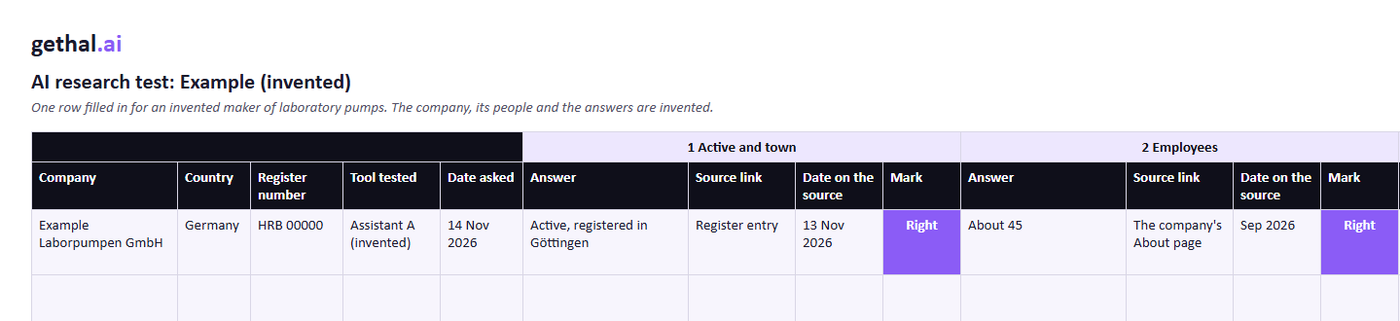
Example (invented): Example Laborpumpen GmbH, a laboratory pump maker in Germany, HRB 00000. The company, its people and the answers are invented.
| Check | Answer | Source | Date on the source | Mark |
|---|---|---|---|---|
| 1. Active and town | Active, registered in Göttingen | Register entry | 13 Nov 2026 | Right |
| 2. Employees | About 45 | The company's About page | Sep 2026 | Right |
| 3. What it makes or sells | Peristaltic and diaphragm pumps for laboratories | None given | No source | |
| 4. Managing director | Dr Jana Beispiel | A trade-press interview | Mar 2021 | Wrong: she left in 2024 and the register names her successor |
| 5. One dated event | "I couldn't find a dated event from the last 12 months." | Unknown |
Check 1 is right, so the run goes on. The wrong managing director is the detail that would have opened your first email.
Bring this test's five questions to a demo, and ask how HAL answers each one. Book a demo
Where HAL fits
HAL, gethal.ai's AI sales agent, works in five stages: find, research, qualify, quality control and draft. Before anyone is contacted, it checks leads against CVR, the Danish company register, proff.dk, a company-data site, and LinkedIn. Your ideal customer profile is configured with you.
For each company, HAL writes an outreach brief and a suggested first email. It sends nothing: you send from your own mailbox, and the replies come to you. HAL can't meet a buyer, run a demo or negotiate a price; that stays with you.
Judge HAL with the same four marks as any other tool, and ask in a demo how it shows where each fact comes from. To weigh it against an agency or doing the work yourself, see the cost per right buyer of each route.
See the outreach brief and suggested first email HAL writes for a company. Book a demo
Whichever tool you consider, get the free AI research test sheet (Excel) and run it first.
FAQ
Does AI make up facts in sales emails?
It can, when a detail comes from the model's memory instead of a page it read. Studies of summaries, search answers and recall all found invented or unsupported details, most often about little-known entities. Check each fact in a draft against a source you've opened.
How often do AI assistants get facts about companies wrong?
Results differ by task and change with each version. The best model on one vendor's leaderboard is reported to hallucinate in about 2 summaries in 100; on the least popular entities, one model in a 2023 study was right on about 1 question in 5. Test the assistant you'd use on ten companies you know.
How out of date is B2B contact data?
Check every name on the day you write, whatever the list's age. People move: US private-sector employees had been with their current employer a median of 3.9 years in January 2026 (Bureau of Labor Statistics). Registers such as Companies House don't check what's filed either.
How do I check what an AI wrote before I send it?
Open the link behind every fact in the draft and check the page says the same, with a date. Check the company and the person against the register entry. Cut any detail you can't source.
For what the first email itself should say, see our first cold email template.
Can an AI sales agent research companies accurately?
In these studies, models did better on pages they read than from memory, and worst on little-known entities, which we read most small companies to be. Test the one you're considering on ten companies you know, and ask it to show a source and date for every field.
Run the test before you trust the tool
Run the prompt on ten companies you know this week. To see how HAL shows where a fact comes from, book a demo.
Keep reading: Company research checklist · Outbound agency or AI sales agent? · First cold email template
What changed: nothing yet